Your Cart is Empty
Start shopping
HYALGAN®
HYALGAN® is differentiated by its natural-origin sodium hyaluronate and the depth of its clinical history. It is derived from highly purified, avian-sourced HA with a commonly reported average molecular weight of approximately 500–730 kDa — a natural-chain, non-crosslinked product studied in peer-reviewed RCTs since the 1980s. Looking to buy HYALGAN® online? Licensed professionals can contact the Med Supply Solutions team for guidance on availability, documentation, and account support.

1 items
Sort by
Filters
Category
Brand
Price Range
$
$
Global Best Sellers

Why Orthopedic Practitioners Choose HYALGAN®
HYALGAN® is a sodium hyaluronate viscosupplement injection for knee osteoarthritis, developed by Fidia Farmaceutici of Italy. This company has a longstanding focus on HA-based medical products. FDA PMA-approved in 1997, HYALGAN® is one of the earliest PMA-approved viscosupplements in the US market and carries over 25 years of post-approval clinical data. [1][2][4] Its 1997 FDA PMA approval gives it one of the longest approval tenures in the viscosupplement category, and its clinical dataset, spanning more than 24 published trials, remains among the most extensive in the field. [1][2][4] Its second differentiator is the structured multi-injection protocol. HYALGAN®'s labeled regimen is five weekly intra-articular injections, which was the protocol used in pivotal trials demonstrating efficacy and tolerability. Some analyses have also evaluated shorter courses of three injections, with comparable pain relief reported in certain studies — practitioners may refer to the clinical literature for guidance on course length based on individual patient profile. For practices that value staged assessment of response and tolerability across a treatment series, the 5-injection course offers a structured monitoring framework. [1][2]Order HYALGAN® at Wholesale Prices
Healthcare professionals can contact the Med Supply Solutions team for information on HYALGAN® availability, documentation, LOT verification, and account requirements. Looking to order HYALGAN® online or source HYALGAN® wholesale for clinical use? Get in touch with the team at Med Supply Solutions for procurement guidance.What Is HYALGAN® Used For?
HYALGAN® is indicated for the relief of pain in osteoarthritis of the knee in patients who have not responded adequately to conservative non-pharmacologic therapy and simple analgesics. It is intended as an intra-articular viscosupplement, not as a curative therapy, and should be selected according to patient history, OA severity, prior treatment response, and clinical judgment. [2][4] The proposed mechanism involves supplementing the synovial fluid of osteoarthritic joints, where both HA concentration and molecular weight are typically reduced. Intra-articular delivery of sodium hyaluronate is thought to help restore the viscoelastic properties of the joint fluid, supporting lubrication and shock absorption during movement. [5]HYALGAN® Product Presentation
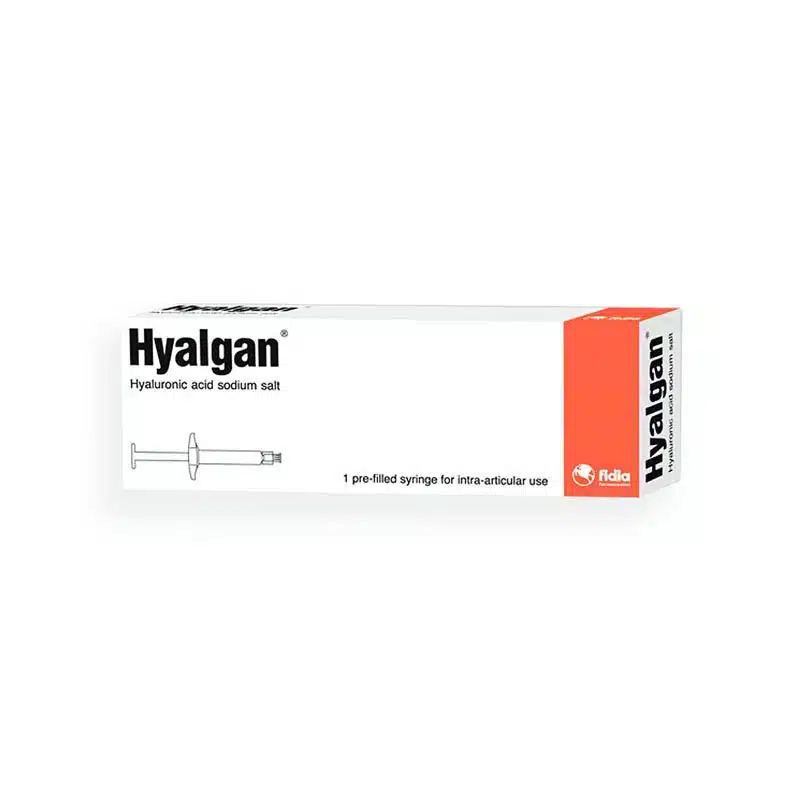
HYALGAN® is supplied as a 2 mL prefilled syringe containing 20 mg of sodium hyaluronate (10 mg/mL). The product is highly purified, avian-derived from rooster comb, and intended for intra-articular injection into the knee joint only. [5] The labeled regimen is one injection weekly for 5 weeks; some clinical studies have also evaluated shorter 3-injection courses. HYALGAN® should be stored at room temperature up to 25°C/77°F and must not be frozen. Practitioners should consult the current prescribing information for handling, storage, and dosing guidance. [2][5]HYALGAN® vs Other Viscosupplements
HYALGAN® differs from competing viscosupplements in HA source, molecular structure, and injection schedule. It uses natural-chain, avian-derived sodium hyaluronate (approximately 500–730 kDa) administered across a 5-injection weekly protocol. SYNVISC® uses crosslinked hylan G-F 20, a higher-molecular-weight derivative (~6,000 kDa), available in both multi-injection and single-injection formats. The crosslinked structure of hylan G-F 20 differs fundamentally from HYALGAN®'s natural-chain HA — some practitioners consider this distinction relevant for patients with sensitivity concerns relating to crosslinked products. ORTHOVISC® and EUFLEXXA® are both produced through bacterial fermentation, making them non-avian alternatives. ORTHOVISC® is typically used in a 3- or 4-injection regimen; EUFLEXXA® is commonly administered as a 3-injection series and received FDA approval in 2004. For practitioners who need to avoid avian-sourced products, both represent clinically relevant options. HYALGAN®'s avian origin, natural-chain HA profile, and earlier PMA approval history (1997) distinguish it within this sub-category. Durolane offers a different treatment model: a single-injection NASHA® technology product suited to practices where minimizing patient visits and maintaining compliance are priorities. HYALGAN®'s 5-injection protocol requires more appointments, though some analyses report comparable relief with shorter HYALGAN® courses — practitioners should consider individual patient profile and current clinical guidance when selecting a regimen length.About HYALGAN®
HYALGAN® was developed by Fidia Farmaceutici S.p.A., based in Abano Terme, Italy, and founded in 1946. Fidia has a longstanding focus on hyaluronic acid research and was among the first companies to commercialize HA-based medical products for joint and tissue applications. HYALGAN® was introduced clinically in Europe in the 1980s and received FDA PMA approval on August 12, 1997 (P950027). HYALGAN® is one of the earliest PMA-approved viscosupplements in the US market. [4][5] The brand is positioned as a long-established sodium hyaluronate viscosupplement with over 25 years of post-market clinical data. Its avian-sourced, natural-chain HA profile distinguishes it from both crosslinked hylan products and bacterial fermentation-derived alternatives — making HA source, molecular weight, injection schedule, and regulatory history the principal comparative factors for clinical and procurement evaluation.HYALGAN® Safety Profile
Common reactions following HYALGAN® injection may include injection-site pain or discomfort, swelling, warmth, redness, local joint pain, bruising, rash, itching, headache, or gastrointestinal complaints. These effects are typically mild and transient, with most local reactions resolving within 1–3 days, though duration may vary by patient and joint condition. [5] HYALGAN® is contraindicated in patients with known hypersensitivity to hyaluronate preparations and should not be injected into a knee with active infection or through skin affected by infection or disease. Because HYALGAN® is avian-derived from rooster comb, it is contraindicated in patients with known hypersensitivity to bird proteins, feathers, or egg products — a clinically important distinction from bacterial fermentation-derived viscosupplements, which do not carry this restriction. [5] Anaphylactoid and allergic reactions have been reported with HYALGAN®. Practitioners administering viscosupplement injections should maintain standard protocols for recognizing and managing hypersensitivity reactions, including anaphylaxis, and should monitor patients appropriately following each injection. [5]HYALGAN® Regulatory Status
HYALGAN® received FDA premarket approval (PMA P950027) on August 12, 1997, for the relief of pain in osteoarthritis of the knee. [4] HYALGAN® was approved through the PMA pathway as an intra-articular medical device rather than through a traditional new drug application. Its regulatory distinction has practical implications for orthopedic practices, as it affects procurement documentation requirements and, in some states, coverage considerations. [4] HYALGAN® is also available in the EU and multiple international markets. Local labeling, approved indications, and distribution pathways vary by jurisdiction. Practitioners should verify current documentation and applicable local requirements before clinical use.How Long Does HYALGAN® Last?
Duration of effect varies by patient, disease severity, and individual response. Clinical studies report pain relief lasting up to approximately 6 months following a 5-injection course, with some patients experiencing benefit beyond that period. Repeat treatment at approximately 6-month intervals has been evaluated in published clinical data. [2][2]Administration Overview
- HYALGAN® is administered as an intra-articular injection into the knee joint by a trained orthopedic surgeon, rheumatologist, sports medicine physician, or physical medicine specialist.
- The labeled regimen is one injection weekly for 5 weeks, with each syringe intended for single use; some clinical protocols have evaluated shorter 3-injection courses. Practitioners should follow current prescribing information for dosing guidance. [1][2][4][5]
- If joint effusion is present before injection, aspiration supports accurate product placement and may reduce post-injection discomfort.
FAQs
1. What is HYALGAN® used for?
HYALGAN® is indicated for pain relief in knee osteoarthritis through intra-articular viscosupplementation. It is FDA-approved for patients who have not responded adequately to conservative non-pharmacologic therapy and simple analgesics, and is selected based on patient history, OA severity, and clinical judgment. [2][4]2. How is HYALGAN® administered?
HYALGAN® is injected directly into the knee joint by a trained healthcare professional. The labeled standard protocol is one injection per week for 5 weeks, with some clinical protocols evaluating shorter courses; joint effusion should be removed before injection when present. [1][4]3. How long do HYALGAN® results last?
Clinical studies report pain relief for up to approximately 6 months following a 5-injection course, though duration varies by patient. Repeat treatment at approximately 6-month intervals has been evaluated in clinical practice. [2][2]4. Is HYALGAN® safe for patients allergic to bird proteins?
No. HYALGAN® is avian-derived from rooster comb and is contraindicated in patients with known hypersensitivity to bird proteins, feathers, or egg products. Practitioners should screen for avian protein allergies before use. [5]5. How does HYALGAN® compare to SYNVISC® or ORTHOVISC®?
HYALGAN® uses natural-chain avian-derived sodium hyaluronate (approximately 500–730 kDa) in a 5-injection weekly protocol, with PMA approval dating to 1997. SYNVISC® uses crosslinked hylan G-F 20 and is available in single and multi-injection formats. ORTHOVISC® is derived from bacterial fermentation and is used in a 3- or 4-injection regimen. Key differences in HA source, molecular structure, and injection schedule are covered in the comparison section above.6. Is HYALGAN® a drug or a medical device?
HYALGAN® was approved through the FDA's PMA pathway as an intra-articular medical device, rather than through a traditional new drug application. This regulatory distinction may affect procurement documentation and, in some states, coverage considerations for orthopedic practices. [4]7. Where can licensed professionals buy HYALGAN® online?
Licensed healthcare professionals looking to buy HYALGAN® online can contact the Med Supply Solutions team for guidance on availability, product documentation, LOT verification, and account setup.Citations
- Altman RD, Moskowitz R. Intraarticular sodium hyaluronate (Hyalgan) in the treatment of patients with osteoarthritis of the knee: a randomized clinical trial. Hyalgan Study Group. J Rheumatol. 1998;25(11):2203-2212. Available at: https://pubmed.ncbi.nlm.nih.gov/9818665/
- Maheu E, Ayral X, Dougados M. A hyaluronan preparation (500-730 kDa) in the treatment of osteoarthritis: a review of clinical trials with Hyalgan. Int J Clin Pract. 2002;56(10):804-813.
- S. Food and Drug Administration. Premarket approval (PMA) P950027: Hyalgan. FDA AccessData. https://www.accessdata.fda.gov/scripts/cdrh/cfdocs/cfpma/pma.cfm?id=P950027
- Fidia Farmaceutici S.p.A. Using HYALGAN. https://www.hyalgan.com/hcp/why-hyalgan/
Newsletter
Subscribe for exclusive offers and updates on new arrivals